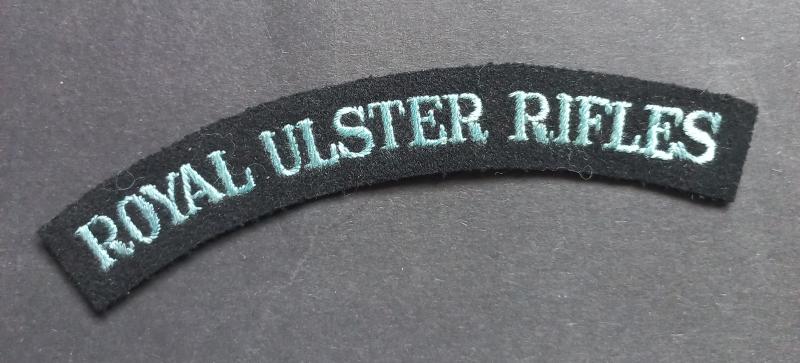
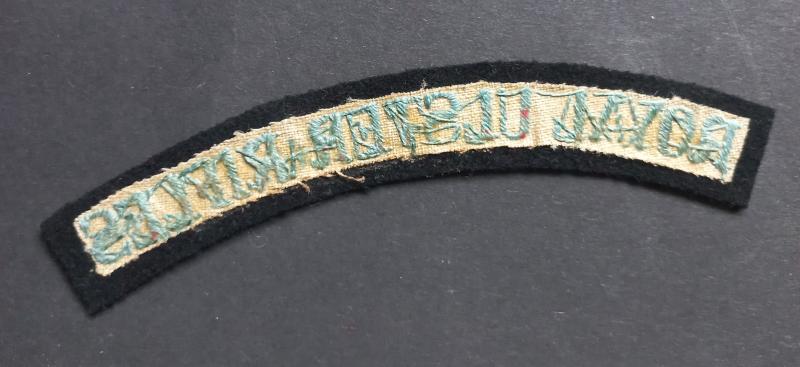
A superb and rarely seen - albeit regrettably single - early Royal Ulster Rifles embroided shoulder title
This is a superb example of a rarely seen - albeit regrettably single - early Royal Ulster Rifles embroided shoulder title as worn by members of the 1st Battalion who became part of the 1st Airlanding Brigade in October 1941. The 1st Royal Ulster Rifles had been stationed in India at the outbreak of hostilities, but returned in time to help defend Dunkirk and evacuate the British Expeditionary Force. The Battalion soon became a part of the 31st Independent Infantry Brigade and was billeted in Wales, where they assumed a coastal defence role. Over the coming months the Brigade was moved to various locations in the East Anglia, London, and Kent areas, before returning to Wales in February 1941 for a more long-term posting in the Black Mountains. It was here, until the end of the year, that the Brigade trained extensively in mountain warfare, travelling light and fast with pack-transport; hundreds of horses and mules. Such specialist activities had considerable repercussions for the future of the Brigade.
At this stage in the war, the British Airborne Forces consisted of just the 1st Parachute Brigade, however in September 1941, the War Office decided that a Brigade of glider infantry should be raised to compliment them. The 31st Infantry Brigade was selected for this task and accordingly, on the 10th October of that year, it was renamed the 1st Airlanding Brigade. In addition to the 1st Royal Ulster Rifles, this experimental formation consisted of a further three battalions; the 1st Border, 2nd Oxford and Buckinghamshire Light Infantry, and 2nd South Staffordshires. Gliders were seen as a necessary method of supporting airborne operations, as they were able to carry additional infantry to reinforce the parachute brigades, and also heavy equipment, such as Jeeps and anti-tank guns. It was this factor, and the subsequent formation of the 1st Airborne Division, that made it possible for the role of the British Airborne Forces to advance beyond the small-scale and infrequent commando raids that had been previously envisaged.
Nevertheless, twenty months of training passed before the Brigade was earmarked for an action. The 1st Parachute Brigade had been detached since late 1942 and had been involved in heavy fighting in North Africa, and with hostilities in that continent at an end, the 1st Airlanding Brigade was called to join them in May 1943 to prepare for an invasion of Sicily. The 1st Royal Ulster Rifles and 2nd Oxfordshire and Buckinghamshire Light Infantry, however, did not accompany the Brigade, but were instead detached to form the experienced nucleus of the 6th Airlanding Brigade. As a part of the newly raised 6th Airborne Division, their task was now to prepare themselves for the invasion of France.
Code: 52423